

Many businesses spend significant money on marketing, advertising, and lead generation but struggle to convert visitors into paying customers.
The problem isn’t always traffic.
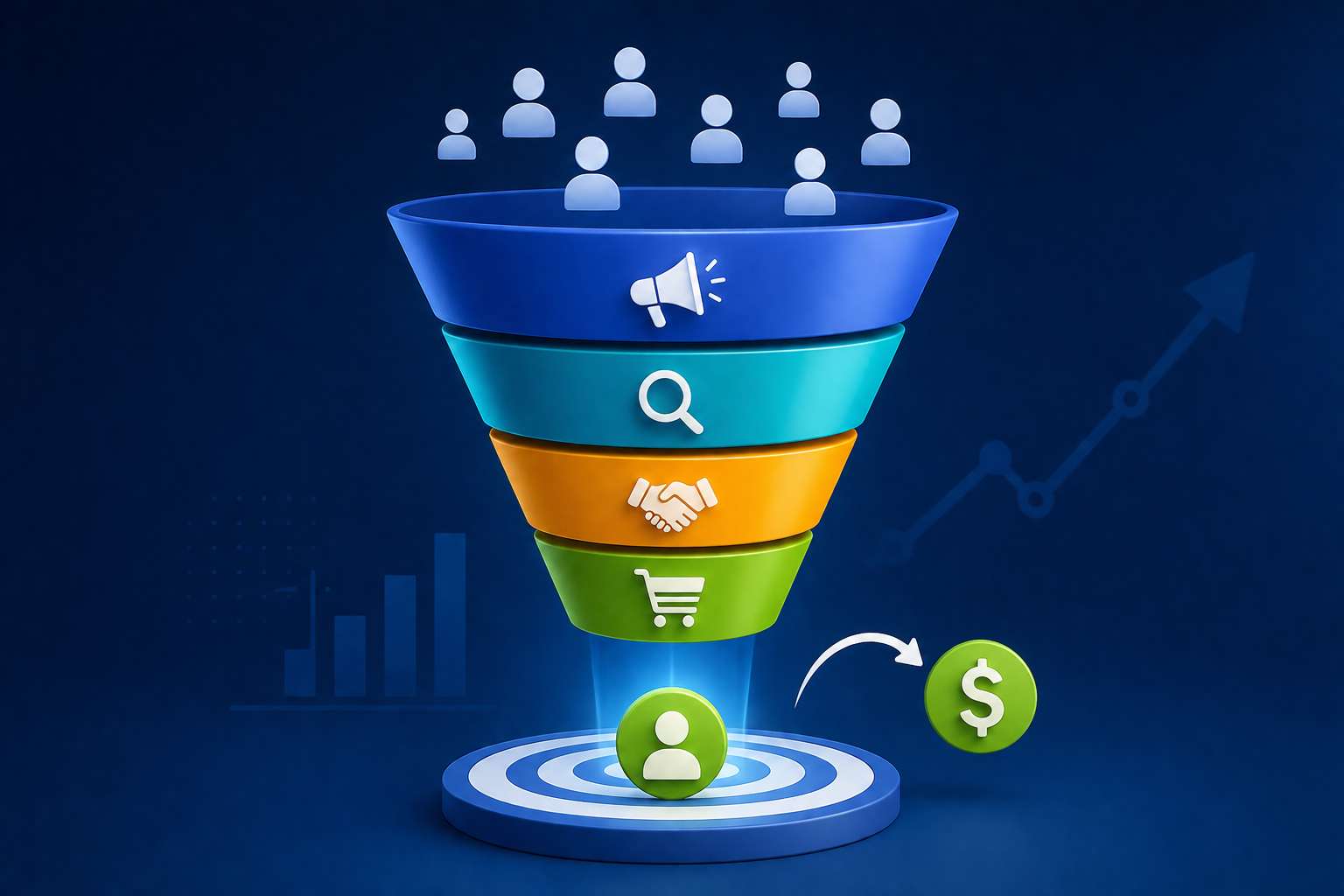
In many cases, businesses lack a structured process for moving prospects from awareness to purchase. This is where a sales funnel becomes essential.
A sales funnel helps guide potential customers through a strategic journey, turning strangers into leads and leads into loyal customers.
In this guide, we’ll explore what a sales funnel is, how it works, and why every business should have one in place.
What Is a Sales Funnel?
A sales funnel is the step-by-step process a potential customer follows before making a purchase.
It’s called a funnel because many people enter at the top, but only a portion become customers at the bottom.
Think of it as a roadmap that guides prospects through different stages of decision-making.
Instead of hoping visitors eventually buy, a sales funnel intentionally moves them toward a conversion.
Why Most Businesses Struggle Without a Funnel
Many businesses operate like this:
- Run ads
- Send traffic to a website
- Hope visitors contact them
- Follow up manually
Unfortunately, this approach often leads to:
- Lost leads
- Low conversion rates
- Inconsistent revenue
- Higher marketing costs
- Poor customer experiences
Without a funnel, businesses leave money on the table every day.
The Four Stages of a Sales Funnel
Every successful funnel is built around four primary stages.
Stage 1: Awareness
At this stage, potential customers become aware of your brand, product, or service.
They may discover you through:
- Google searches
- Social media
- Paid advertisements
- Blog articles
- YouTube videos
- Referrals
The goal is simple:
Get attention.
This stage focuses on educating and attracting your ideal audience.
Stage 2: Interest
Once prospects know you exist, they begin researching solutions.
They may:
- Visit your website
- Read blog content
- Download resources
- Watch videos
- Follow your social channels
Your objective is to build trust and demonstrate expertise.
Helpful content plays a critical role during this phase.
Examples include:
- Guides
- Case studies
- Checklists
- Webinars
- Industry insights
Stage 3: Decision
At this stage, prospects are evaluating options and comparing providers.
They want answers to questions such as:
- Why should I choose your company?
- What makes your service different?
- Can you solve my problem?
- What results can I expect?
Businesses should provide:
- Testimonials
- Success stories
- Product demonstrations
- Free consultations
- Detailed service information
The goal is to remove uncertainty.
Stage 4: Action
This is where the conversion happens.
The prospect:
- Makes a purchase
- Books a consultation
- Requests a quote
- Signs a contract
- Schedules a call
A clear and compelling call-to-action is critical.
The easier the next step, the higher the conversion rate.
How a Sales Funnel Works in Real Life
Imagine you own a digital marketing agency.
A business owner sees one of your blog posts titled:
“10 SEO Mistakes Costing Businesses Thousands of Visitors.”
They read the article and download a free SEO checklist.
To access the checklist, they provide their email address.
They then receive:
- Helpful emails
- Case studies
- Educational resources
Over time, trust develops.
Eventually, they book a free strategy call.
A percentage of those calls become paying clients.
That entire journey is your sales funnel in action.
The Biggest Benefits of Having a Sales Funnel
1. More Qualified Leads
A funnel helps filter out unqualified prospects.
By the time someone reaches the bottom of your funnel, they’re often more informed and ready to buy.
This leads to better sales conversations and higher closing rates.
2. Higher Conversion Rates
Sales funnels are designed to move prospects toward action.
Instead of relying on chance, every step has a purpose.
Businesses with optimized funnels consistently convert more visitors into customers.
3. Predictable Revenue
One of the biggest challenges for business owners is inconsistent revenue.
A well-built funnel creates a predictable system for generating leads and sales.
This makes growth easier to forecast and manage.
4. Better Customer Experience
People don’t like being sold to.
They prefer being educated and guided.
A funnel provides valuable information at every stage, creating a smoother customer journey.
5. Improved Marketing ROI
When every lead enters a structured process, marketing becomes more efficient.
Businesses generate more revenue from the same advertising budget.
This lowers customer acquisition costs and increases profitability.
Essential Components of a High-Converting Sales Funnel
Not all funnels are created equal.
Successful funnels typically include the following elements.
Landing Page
A landing page focuses on one specific offer.
Examples include:
- Free consultation
- Lead magnet
- Product offer
- Webinar registration
Its purpose is to convert visitors into leads.
Lead Magnet
A lead magnet is something valuable offered in exchange for contact information.
Examples:
- Checklists
- Templates
- Free audits
- E-books
- Guides
The best lead magnets solve immediate problems.
Email Follow-Up Sequence
Most prospects don’t buy immediately.
Automated email sequences help nurture leads over time.
These emails:
- Educate
- Build trust
- Address objections
- Present offers
Email marketing remains one of the highest ROI channels available.
Sales Page
A sales page explains:
- The problem
- The solution
- Benefits
- Testimonials
- Pricing
- Next steps
Its goal is to persuade prospects to take action.
Call-to-Action (CTA)
Every funnel needs a clear CTA.
Examples include:
- Book a Call
- Request a Quote
- Start Free Trial
- Get Started Today
Confusing CTAs often reduce conversions.
Common Sales Funnel Mistakes
Many businesses make these errors:
Driving Traffic Without a Funnel
Traffic alone does not guarantee sales.
Visitors need a structured journey.
Asking for Too Much Too Soon
Most prospects aren’t ready to buy immediately.
Build trust before making aggressive sales pitches.
Ignoring Follow-Up
Many leads convert after multiple touchpoints.
Without follow-up, opportunities are lost.
Weak Landing Pages
Poor design, unclear messaging, and weak offers reduce conversions.
No Analytics Tracking
You can’t improve what you don’t measure.
Track:
- Conversion rates
- Landing page performance
- Email open rates
- Cost per lead
- Customer acquisition costs
How to Build Your First Sales Funnel
Step 1: Identify your ideal customer.
Step 2: Create a valuable lead magnet.
Step 3: Build a landing page.
Step 4: Set up email automation.
Step 5: Develop a compelling offer.
Step 6: Drive traffic through SEO, social media, and paid ads.
Step 7: Track performance and optimize continuously.
The best funnels evolve over time based on data and customer behavior.
The Future of Sales Funnels in 2026
Modern sales funnels are becoming smarter through automation and AI.
Businesses are increasingly using:
- AI-powered lead qualification
- Personalized email sequences
- Behavioral tracking
- Marketing automation platforms
- Predictive analytics
The businesses that adopt these systems gain a significant competitive advantage.
Final Thoughts
A sales funnel is more than a marketing tool.
It’s a revenue-generating system that helps businesses attract, nurture, and convert customers consistently.
Without a funnel, businesses often depend on luck.
With a funnel, growth becomes measurable, scalable, and predictable.
Whether you’re a service provider, eCommerce brand, consultant, or local business, investing in a well-designed sales funnel can dramatically improve your marketing results and increase long-term revenue.
 +234 705 022 9352
  uprisedigitalworld01@gmail.com